
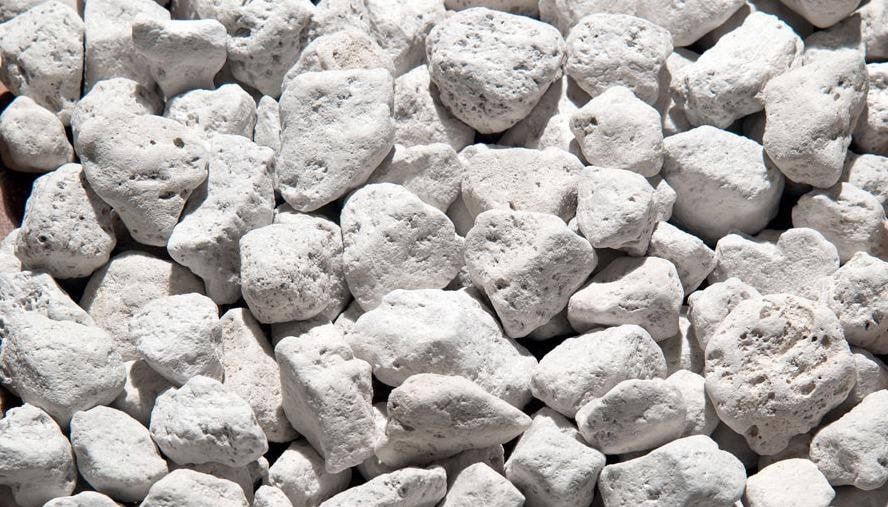
Pumice is a light, porous volcanic rock. In denim finishing it is the classic abrasive for stone washing: tumbled with garments in an industrial washer, it rubs the indigo off the surface of the yarn and gives jeans their worn, faded look. This guide explains what separates a good wash stone from an ordinary one and how to choose the right grade for your program.
What is pumice?
Pumice forms when gas-rich lava is thrown out of a volcano and cools so quickly that it has no time to crystallise. The escaping gas leaves the rock full of small, mostly closed pores. That is why pumice is light (particle density roughly 0.5–1.0 g/cm³), why many pieces float on water, and why it abrades gently instead of cutting.
Most of the pumice used in the textile industry is acidic (rhyolitic) white pumice. It is rich in silica (around 70 % SiO₂), low in iron and light in colour, so it does not stain fabric.
Why Nevşehir pumice is used for denim
Nevşehir, in the Cappadocia region of central Türkiye, sits on some of the largest pumice deposits in the world. The white pumice from this area has three properties that denim laundries value:
- Even pore structure. The stone wears down at a steady rate, so results stay consistent from one cycle to the next.
- Low iron content. Less risk of rust spots and yellow casts, especially in bleached washes.
- White colour. The stone does not leave its own colour on light shades.
How stone-wash pumice is prepared
Raw pumice is not ready for a washing machine. At Cebeci, each lot goes through these steps before it is bagged:
- Selection of white pumice at source in Nevşehir.
- Screening into size ranges, with crushing where needed.
- Washing to remove dust, clay and fines.
- Cleaning out dark volcanic pebbles, contaminants and stones that carry metal oxides.
- Tumbling in drums until the sharp edges are rounded off.
- Drying, so the bag weights you pay for are stone rather than water.
- Inspection and bagging for export.
Choosing a grade
Stone size is the main lever you have over the wash effect. Smaller stones have more contact points and give a softer, more uniform abrasion. Larger stones hit harder and create more contrast on seams, pockets and hems.
| Grade | Size | Typical use | Wash effect |
|---|---|---|---|
| Standard | 2–4 cm | Light to mid-weight denim, most 10–13 oz fabrics, shirts | Even, softer abrasion; fine salt-and-pepper look |
| Coarse | 3–5 cm | Heavier denim, jackets, long cycles | Higher contrast on seams, pockets and hems |
Cebeci supplies these two sizes. Many laundries keep both in stock: 2–4 cm for most programs and 3–5 cm for stronger looks. Both can be loaded in the same container, and custom calibration can be quoted on request.
What to check when a lot arrives
- Size distribution. Stones should sit within the declared range, with few undersized pieces and little dust at the bottom of the bag.
- Colour. White to off-white, without dark or reddish stones mixed in.
- Shape. Rounded, with no sharp edges that could cut fabric.
- Dust. Washed pumice leaves less sludge in machines and drains.
- Bag condition. Bags should arrive intact after loading, transit and storage.
Typical properties
| Property | Typical value |
|---|---|
| Colour | White to off-white |
| Rock type | Acidic volcanic glass (rhyolitic pumice) |
| Particle density | 0.5–1.0 g/cm³ |
| Hardness (Mohs) | approx. 5.5–6 |
| SiO₂ | 70–74 % |
| Al₂O₃ | 12–14 % |
| Fe₂O₃ | < 1.5 % |
| Crystal water | None |
These are indicative values for Nevşehir white pumice. Pumice is a natural material and figures vary by lot; a lot-specific analysis can be supplied with each quotation.
Packing and shipping
Stone-wash pumice from Türkiye is shipped by sea in full container loads. Cebeci packs in woven polypropylene bags or FIBC big bags and loads 20′ or 40′ HC containers, with several grades in one container if required. Quotations are given FOB, CFR or CIF to the port you name. Shipping documents include the commercial invoice, packing list, bill of lading and certificate of origin.
We export worldwide and quote to any port that can receive a sea container, in Asia, Europe, the Americas, Africa and the Middle East. Each shipment is followed until it reaches your port.
Frequently asked questions
Can pumice be reused?
Pumice wears down in every cycle. Stones that are still large enough can often be used again, but broken pieces and sludge should be removed to keep results consistent.
Is pumice the only option for a stone-wash look?
Enzymes and synthetic abrasives can replace part or all of the pumice in some programs. Many laundries combine enzymes with a smaller stone load; natural pumice remains the reference for an authentic stone-washed look.
How much pumice is used per load?
It depends on the machine, the fabric and the look you want. Laundries typically work with a stone-to-garment ratio they have tuned over time. Tell us your program and we will suggest a grade to start with.
Need help choosing a grade?
Send us your fabric and wash program and we will recommend a grade.